 BANARTA

Choosing between underfloor heating staples and fixing rails starts with the complete floor system. A fixing must hold the specified pipe during installation without damaging it or compromising the approved floor build-up. Similar-looking clips are not automatically interchangeable, and a rail does not automatically fit every insulation board.
This guide focuses on compatibility before purchase. It does not specify pipe spacing, circuit design or fixing intervals; those belong in the selected system's installation instructions and project design.
Three fixing approaches to compare
| Approach | How it holds the pipe | What to verify |
|---|---|---|
| Staples or tacker clips | Individual clips anchor into a compatible insulation layer. | Pipe diameter, clip shape and leg length, insulation type and thickness, facing and tacker tool. |
| Fixing rails | A rail positions several pipe runs using its own retaining profile. | Accepted pipe dimensions, rail attachment method, permitted layout and treatment of bends. |
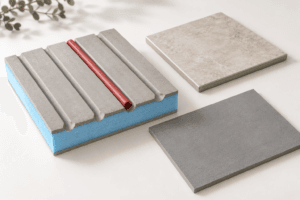
| Castellated panels | A formed panel profile retains the pipe between raised features. | Panel and pipe combination, panel connections, direction changes and floor build-up. |
These are system choices, not a ranking from weak to strong. A correctly specified staple system and a correctly specified panel system may each suit different projects. Do not transfer a fixing detail from one system into another without approval.
Check the pipe and the layer underneath it
Record the pipe's outside diameter and construction, then ask which exact fixing reference accepts it. A clip that feels loose may allow movement; a tight clip may stress the pipe. Neither issue is resolved by ordering more of the same clip.
For staples, obtain confirmation of the insulation material, thickness and any facing. Also establish which layer the clip is designed to enter and whether a membrane or other protected layer is present. Do not assume that a longer leg is better or that penetration of an unfamiliar floor layer is permitted.
For rails, check how the rail itself is secured. An adhesive-backed rail, a mechanically fixed rail and a loose positioning component require different substrate and installation checks. For profiled panels, use the pipe range and assembly method specified for that panel.
Make the purchase description precise
- System reference: identify the floor build-up and the current installation manual.
- Pipe: give the outside diameter, material and approved product reference.
- Support: state the insulation or panel reference, thickness, facing and substrate.
- Fixing: record clip or rail dimensions, pack size and any installation-tool requirement.
- Layout: provide the approved drawing and request quantities based on its fixing rules.
- Delivery: require labelled packs so different clip sizes cannot be mixed on site.
Compare quotations by compatible installed quantity, not by the cheapest bag. A bag count is meaningless without its contents and the approved fixing pattern. Bends, transitions and other details may have different requirements, so a single clips-per-square-metre assumption can mislead.
Use a sample assembly to resolve uncertainty
Before a larger order, review a representative assembly using the actual pipe, board or panel, fixing and tool. Check fit, retention during the intended installation sequence and visible damage. Record any mismatch and resolve it with the system supplier. A successful small assembly helps confirm practical fit; it does not replace design approval, durability evidence or the prescribed pressure test.
For available product options, review underfloor heating accessories and EPS underfloor heating panels. See also matching panels, pipes and floor finishes. Send your system reference, pipe details and layout when requesting a quotation; availability and compatibility must be confirmed for the proposed configuration.
Technical reference: Uponor's Tacker system overview illustrates a specified clip-and-insulation approach. Its details apply to that system and are not evidence of Banarta product performance.