 BANARTA
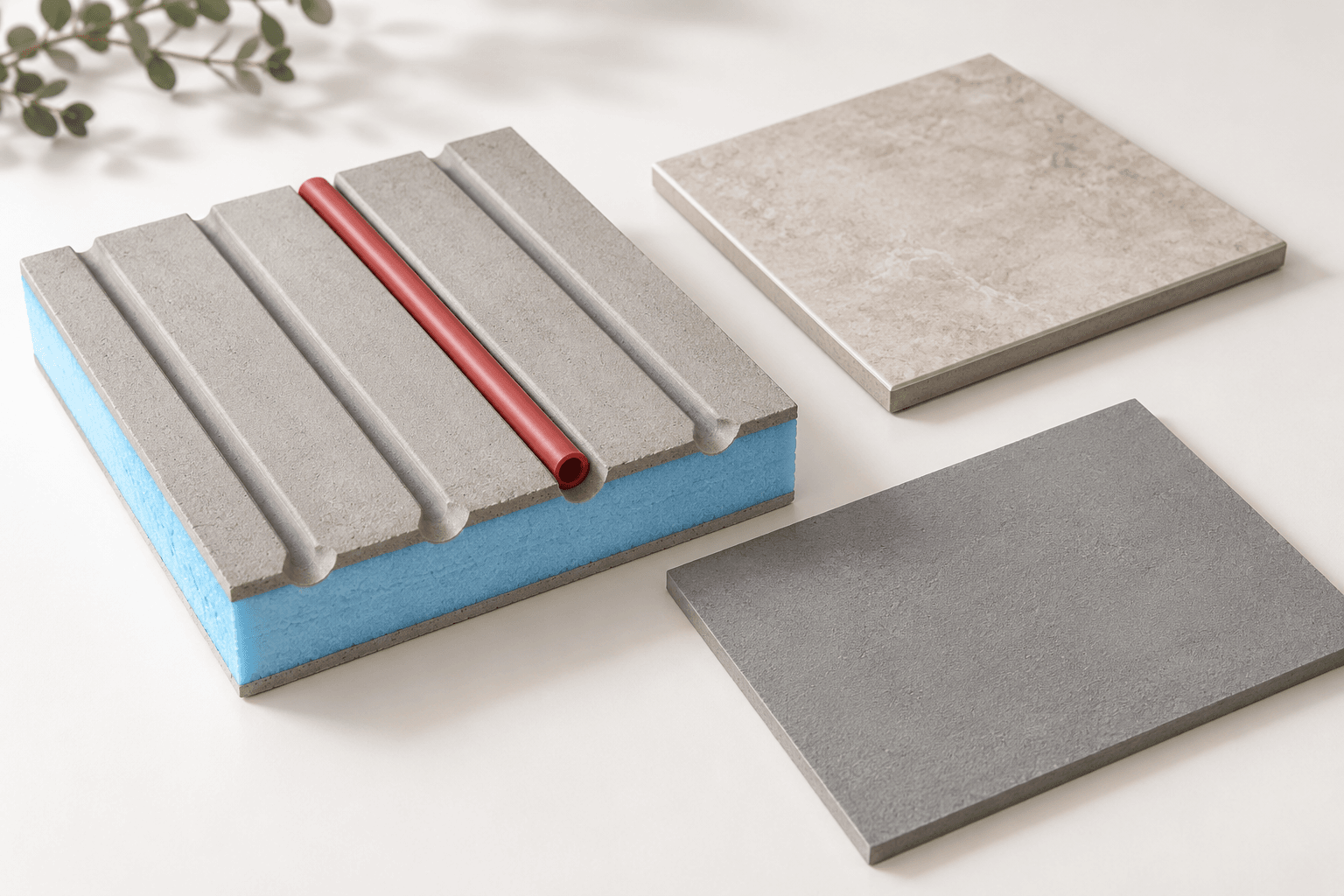
Selected cement-coated grooved XPS heating boards are offered for tiling with adhesive after water-pipe installation. That supply option makes them a candidate for a tiled floor, but the coating description alone does not establish the complete installation. Choose between tiling over the specified board, adding a covering layer, or using a screeded system before comparing purchase packages.
Choose between three floor-assembly routes
Start with the layer immediately beneath the tile adhesive. Is it the coated heating board itself, a separate covering layer, or the finished screed? This answer determines which materials belong in the purchase package.
| Proposed route | What the buyer is selecting | What stays in the package |
|---|---|---|
| Tile adhesive over a cement-coated grooved board | A coated board with channels matching the specified water pipe, within a permitted direct-tiling assembly | Board-to-base attachment, treatment of channels and joints, required surface preparation, and the specified adhesive and tile |
| A separate covering layer over the heating panel | The heating panel plus the overlay or levelling construction required by that system | The covering layer and its attachment or preparation; its added height and thermal resistance remain in the design |
| Studded EPS panels below screed | A pipe-positioning and insulation system for a designed wet floor construction | The specified screed and its curing, moisture and finish requirements, together with panel-joint and perimeter details |
These are routes for evaluation, not interchangeable installation instructions. Select the route accepted for the project before comparing board-only prices. Removing a layer from a quotation is not the same as removing it from the approved construction.
What Banarta's coated grooved option offers
The grooved XPS tile backer board product page describes a mortar-coated XPS panel with preformed pipe channels. Its published options include 1200 × 600 mm panels, 20–50 mm board thickness and grooves for 16 mm or 20 mm pipe. Those ranges are enquiry options: they do not establish that every thickness, groove and pipe combination is available or suitable together.
Banarta references 1601819200142 and 1601819133287 are cement-and-fiberglass-faced grooved XPS boards offered for tiling with tile adhesive after pipe installation. Select the exact board configuration together with the matched adhesive, joint treatment and project build-up. This supply description does not approve every adhesive or certify the complete floor assembly.
A flat cement-coated XPS backer board provides a tile-backing surface without the routed water-pipe channels described above. A flat board ordered by the same thickness is not a substitute for a grooved board in a pipe layout.
What “direct tile” leaves to resolve
The phrase directs attention to a possible omission of a separate covering layer. It does not describe all the interfaces in the floor. Read the proposed section from bottom to top:
- Supporting floor to board. Identify the existing substrate and the permitted way to support and attach the board. A method intended for one base should not silently become the method for another.
- Board surface around the pipe channels. Mark where the coated face, open channels, pipe and cut edges occur. Resolve how the specified assembly treats those different surfaces before buying adhesive or filling materials.
- Board joints and changes of direction. Include joints between panels, cut pieces, return areas and transitions to a different floor construction. A straight field of panels is not the whole room.
- Prepared surface to tile. Identify the permitted preparation and bonding materials for the selected board and tile. Keep the tile type and format attached to the decision rather than using “ceramic finish” as the whole description.
When comparing two offers, identify which interfaces each proposal covers. A cheaper board offer may leave an overlay, bonding material or joint component outside its scope. Compare the complete selected package before deciding which offer is more economical.
How a finish change alters a purchase
Published manufacturer systems illustrate the issue. Tekwarm's Lite LP description separates its tile route from finishes that use an additional construction board. Snug's Cemboard information gives different preparation routes for tile and resilient finishes. Their details apply to their own systems; they are not Banarta installation specifications.
Consider a hypothetical purchase decision. A tiled room is being quoted with a coated grooved board, while an adjoining room will receive vinyl. Copying the tiled-room material list and changing only the finish name leaves the vinyl support and preparation unresolved. Keep two assembly lines: the tiled route, and the vinyl route with its selected covering construction. Once both are established, compare the finished levels at the doorway and revise the materials ordered for each room.
No extra layer thickness or adhesive consumption is assumed here. Those inputs come from the selected construction. The example shows how to organise the decision without inventing a universal floor recipe.
Apply a substitution test
| Proposed change | Decision before accepting it |
|---|---|
| Flat backer board instead of a grooved board | Does the design still provide the required water-pipe route? If not, treat this as a different construction. |
| Different coating or an aluminium-faced panel | Re-establish the surface beneath the tile and its permitted covering and bonding route. Matching pipe diameter alone does not settle the tiled finish. |
| Different pipe size or groove pattern | Match the actual pipe and layout to the proposed board. Do not infer groove compatibility from a board-thickness range. |
| Different tile or a change to vinyl, carpet or timber | Revisit the finish support and preparation, then the total floor height. Keep the changed room separate until its assembly is resolved. |
If the change affects an interface, update the assembly before treating the offer as equivalent. If an interface remains unspecified, keep that part of the order pending rather than filling the gap with a product from another manufacturer's installation example.
Move from the selected route to a purchase
For a coated-board enquiry, send Banarta the selected layer section, pipe layout and required board quantities, with each differing floor finish identified. Ask for the proposed board configuration against that route. For a screeded design, start with the studded EPS heating panel instead of treating it as a direct replacement beneath tile adhesive.
The broader panel, pipe and floor-finish guide covers pipe and layout coordination. Use the route decision here to establish what sits above and below the selected coated board, then keep those interfaces attached to the order through any substitution.