 BANARTA

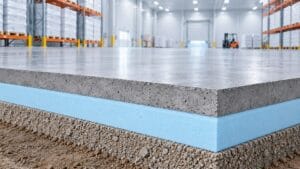
A short-term compression figure is not an allowable permanent floor load. XPS compressive strength or stress is reported under stated test conditions. Compressive creep concerns deformation over time under sustained stress. A project needing long-term support must address both, together with the layers that distribute the load.
Read the condition attached to the number
| Supplier field | Question to ask | Decision it supports |
|---|---|---|
| Compression result | At what strain or failure criterion, and using which method? | Comparison of identified grades on the same basis |
| Creep declaration | At what stress, duration and deformation limit? | Review of sustained-load suitability |
| Design recommendation | For which application and construction? | Selection by the responsible designer |
| Density | Is there separate mechanical evidence? | Identification; not a substitute for load data |
Two documents can display the same unit, kPa, while describing different tests. Put their conditions beside the values before comparing them. Do not derive a long-term value by applying an invented percentage to a short-term number. A higher density alone also does not establish that two grades have equivalent performance.
Why load area changes the question
For a simple illustration, a 2 kN force spread uniformly over 1 m² produces 2 kPa. The same force over 0.01 m² produces 200 kPa before any spreading through other materials. This arithmetic explains why a room-average load cannot describe every concentrated contact.
These are hypothetical inputs, not a floor design or a Banarta load rating. In an actual floor, the finish, screed or other distribution layer, contact area and supporting structure all matter. The designer determines the relevant stress at the insulation, the loading combinations and acceptable deformation.
Define the loads before buying a grade
- Identify the intended floor, roof or other assembly and the board position within it.
- Separate permanent loads from temporary use, movement and concentrated contacts.
- Record equipment feet, storage supports and other local loads that need specific review.
- Provide the proposed layers above and below the insulation, including support continuity.
- Agree the permitted movement and the evidence the designer needs to approve the grade.
For a bulk order, keep this design brief separate from the commercial schedule. A quotation that lists board dimensions and price may still leave the design requirement unresolved. Mark that line as awaiting technical approval rather than assuming the quotation confirms the entire floor.
Separate the technical review from the quantity order
Use two attachments for an enquiry: the designer's load and deformation requirements, and a commercial schedule listing dimensions, grade, pieces and destination. The board and pack calculation guide helps prepare the second document; it does not determine the approved strength grade.
Ask about the proposed XPS configuration and request the compression and creep evidence needed for review. Keep technical approval pending until the responsible designer has checked the exact product and assembly.
Handle supplier substitutions explicitly
If a supplier proposes another XPS grade, compare the exact thermal, compression and creep documents. Check whether the evidence covers the proposed thickness and use. Record the substitute name, differences, review decision and date. Do not allow a description such as “same density” to silently replace the approved grade.
A useful approval record has three outcomes: accepted for the specified assembly, awaiting evidence, or rejected with a reason. This prevents an unresolved question from disappearing when the order moves from purchasing to the warehouse.
Prepare the enquiry
Review XPS insulation options alongside the floor assembly guide. Send the required grade evidence, board schedule and project conditions through Banarta's enquiry page. Available grades and supporting documents require confirmation for the quoted product.
Reference and scope
Ravago's XPS learning resource distinguishes design compression considerations including creep. It is a useful explanation of why the test context matters; its product values are not Banarta specifications.