 BANARTA

Do not rank XPS quotations by the lowest water-absorption percentage until the test and reporting basis match. A total-immersion result, a diffusion result and a water-vapour resistance factor describe different properties. Put each in its own column before deciding whether a proposed board meets the project requirement.
This guide helps buyers read supplied documents. It does not assign a water-absorption class to Banarta boards or select a waterproofing system.
Three labels that belong in separate columns
The European XPS Association’s example declaration distinguishes WL(T), WD(V) and MU. Keep those distinctions when transferring information from a datasheet into a quotation comparison.
On a narrow screen, scroll the table sideways to see all columns.
| Label in the document | What the result describes | Record beside the value | Keep out of this column |
|---|---|---|---|
| WL(T) | Long-term water absorption by total immersion | Reported units, method and edition; product and thickness covered; declared level or measured result | Partial-immersion, diffusion or unspecified soak results |
| WD(V) | Long-term water absorption by diffusion | Reported units, method and edition; applicable thickness range; declared level or measured result | A WL(T) value copied across because it is also a percentage |
| MU or μ | Water-vapour diffusion resistance factor | The factor and its stated test basis; relevant product configuration | An absorption percentage or a waterproofing claim |
MU is a factor, not a percentage of water absorbed. For example, the Synthos XPS PRIME G datasheet, page 11, lists it separately with no physical unit. A larger or smaller MU number cannot be used to fill a missing WL(T) or WD(V) result.
Why immersion and diffusion are not interchangeable
Immersion tests expose a specimen to liquid water; the method must identify whether immersion is partial or total. Diffusion testing uses a vapour-pressure difference and temperature gradient. These are different exposures, not two names for the same test. Polyfoam’s technical explanation describes the distinction; its product claims apply to its own boards.
A real document illustrates the issue: Sika’s August 2020 Sikatherm XPS 300 RZ sheet, page 2, lists 0.7 vol% for total immersion and 3.0 vol% for diffusion for that named product. Those two entries are not contradictory. They occupy different test columns. Neither value is a Banarta specification.
Laboratory results also need their intended scope. The ISO 16535 immersion scope explains that total-immersion testing is not a direct representation of site conditions. A test percentage therefore cannot, by itself, predict the water content of a particular installed floor or establish that its joints and penetrations are watertight.
Keep the standard edition attached to the number
Older sheets commonly cite EN 12087 for immersion and EN 12088 for diffusion. BSI lists BS EN ISO 16535:2019 and BS EN ISO 16536:2019 as their respective successors in the UK.
Copy the reference actually stated in the supplier’s document. Do not relabel an older test as a newer one. Where the project specifies an edition or national adoption, have the responsible reviewer confirm whether the supplied evidence is acceptable; a familiar code alone does not settle that question.
Three quotation mistakes, corrected
The following offers are hypothetical. They demonstrate document handling, not product recommendations or required acceptance limits.
1. A lower percentage from a different test
Offer A states “WL(T), ≤0.7 vol%, total immersion.” Offer B states “WD(V), ≤3.0 vol%, diffusion.” A spreadsheet puts both under “water absorption” and highlights A as the better board.
Correction: A has supplied an immersion entry; B has supplied a diffusion entry. Create both columns and mark the opposite cells “not supplied.” First identify which evidence the project requires, then obtain the missing corresponding entries. Do not calculate a percentage improvement between these figures.
2. A value that does not cover the ordered thickness
A quotation is for 40 mm board, but its attached diffusion result is explicitly limited to boards at least 100 mm thick. The buyer copies that result into the 40 mm order line.
Correction: mark that entry “does not yet cover this thickness.” Request the declaration or report applicable to 40 mm rather than extending the result by assumption. Thickness-specific diffusion entries appear in DIBt’s 2019 assessment for named Styrodur boards, page 6; that does not establish a universal thickness rule for other products.
3. An average compared with a declared limit
Offer C advertises an average achieved immersion result of 0.25 vol% and separately declares a limit of ≤0.7 vol%. Offer D supplies a declared limit of ≤0.5 vol%. The comparison uses C’s average against D’s limit.
Correction: keep averages or individual measurements in a supporting-results field. Place the declared limits together only after the method, units and configuration have been checked. Do not promote an average to an order acceptance limit without an explicit agreement. The same manufacturer’s sheet separates declared and average-achieved immersion rows, showing why those labels matter.
A compact comparison record for each proposed board
Copy this record once per configuration. Use “not supplied” for unknowns; do not insert zero.
- Board identity: supplier’s product/grade, thickness and surface condition; quotation line.
- Immersion entry: value and units; total or partial; method/edition; declared limit or measured result; document page and revision.
- Diffusion entry: value and units; method/edition; thickness coverage; declared limit or measured result; document page and revision.
- Vapour factor, if required: MU/μ and its basis, recorded separately.
- Comparison decision: comparable for the specified property, missing evidence, or outside the documented configuration. Record the unresolved difference.
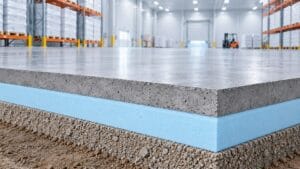
These statuses organise the evidence; they do not approve the assembly. Keep moisture-control layers, drainage and junctions in the project design. For floor coordination, use the floor insulation support and moisture guide.
Apply the comparison to a Banarta enquiry
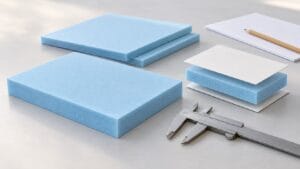
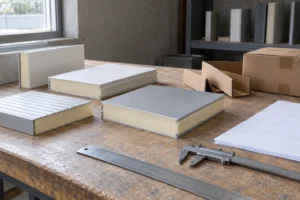
Start with the uncoated XPS board range, which lists skinned, unskinned and grooved surface options. Identify the exact thickness, grade and surface to be quoted, then request the water-related evidence that covers that configuration and the project’s required test basis.
The published range does not establish a WL(T) or WD(V) class for every board option. Send the proposed configuration and the relevant comparison fields with the quantity and destination. Leave unsupported performance entries pending rather than borrowing a value from another manufacturer or thickness.