 BANARTA

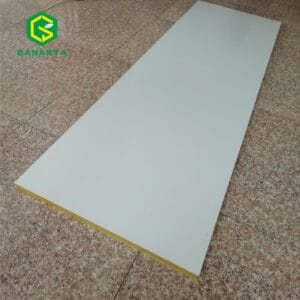
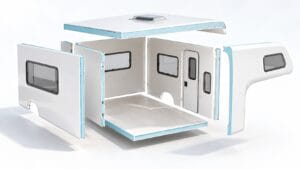
“XPS sandwich panel” describes a family of constructions. Two panels with the same overall thickness may have different facings, core grades, bonding arrangements and edge details. Specify the complete construction before comparing price or assuming a panel is suitable for a particular building element.
What does “20 mm sandwich panel” leave undecided?
It does not say whether 20 mm is the core thickness or the finished panel thickness. It also leaves both skins undefined. Use a section that identifies face A, bond line, XPS core, bond line and face B. Bonding layers occupy thickness too; two facing thicknesses cannot simply be ignored to make a panel fit its frame.
| Example enquiry field | What a complete line would identify |
|---|---|
| Finished thickness | 20 mm overall, with the required tolerance stated on the drawing |
| Face A | Named PVC skin, specified thickness, colour and finish |
| Face B | Named skin and thickness; explicitly state if different from face A |
| Core | Selected XPS grade and a core thickness compatible with the complete construction |
| Supply condition | Bonded finished panel or bare core; cut size, edges, openings and protective film |
This is an example specification format, not confirmation that a particular 20 mm construction is available. The supplier’s section and quotation should resolve the layer dimensions rather than assuming the same core can produce every finished thickness.
Separate a cheaper core quote from a cheaper finished-panel quote
For an illustrative 1.2 × 2.4 m panel, one piece equals 2.88 m². Divide a quoted piece price by 2.88 to obtain a comparable area price, then compare identical facings, thicknesses, machining and packing. A bare-core offer excludes the skins and lamination; a full-sheet offer can exclude cutting and edge finishing. Neither is necessarily a lower-priced equivalent of the required finished part.
Choose the PVC-faced panel, FRP-faced panel or aluminium-skin panel route first. Use the weight calculation to compare handling requirements separately from price.
Write the panel from one face to the other
Name the material, thickness and finish of face A; identify the XPS core and its thickness; then define face B separately. Note any protective film and fabrication requirements. Banarta lists several facing options, including HPL, PVC, FRP, ACP, SPC, plywood and aluminium sheet. Listing an option does not establish its suitability for every environment.
Review the PVC-faced XPS panel for wall and door enquiries and the FRP-faced XPS sandwich panel when defining the facing. For a metal skin, review the aluminum-sheet-faced XPS sandwich panel; identify the sheet on each face rather than substituting a foil-faced insulation board. Specify skin thickness, finish, edges and service conditions for the chosen construction.
| Part of the specification | Questions for the project |
|---|---|
| Face A and face B | Which side is exposed? What finish, cleaning and moisture conditions apply? |
| Core | What thickness and grade does the design require? |
| Finished panel | What overall thickness, flatness, tolerances and evidence are needed? |
| Connections | What supports, fixings, joints and edge closures are specified? |
| Exposure | Indoor/outdoor conditions, temperatures and any special requirements |
| Supply | Panel schedule, cut-outs, packing and identification |

Separate core properties from panel performance
Core compressive strength does not establish the bending capacity of a finished panel, the permitted support span or the performance of a wall. Facings, bonding, geometry, supports and connections all form part of the design. Where a project has structural, fire, thermal or acoustic requirements, request evidence applicable to the actual configuration and its intended use.
Buying core material for your own lamination process? Start with XPS foam core boards for OEM supply, or review slotted XPS cores for panel fabrication when you have a machining drawing. State the core dimensions, surface on each side, proposed facings, bonding process and quantity per part. Ask the quotation to separate bare core supply, machining and any lamination. Agree the material specification and a trial in your intended process before approving bulk supply; a core sample alone does not verify the finished panel.
Let the use determine the questions
A partition, a lining and a refrigerated enclosure may have different demands. For example, a surface exposed to regular cleaning needs a defined finish and compatible joint treatment. An opening requires edge and connection details. Discuss these conditions before choosing a facing from a sample colour alone.
A useful first enquiry
- Attach the proposed section and support arrangement.
- Specify both facings rather than writing only the visible colour.
- List overall dimensions, quantities and cut-outs on a drawing.
- State required reports and the destination’s project requirements.
- Ask the supplier to identify exceptions and confirm the quoted construction.
Use the XPS Foam Composite Panels range to start that discussion. A configuration-specific answer is more useful than a general promise that one panel can serve every application.
Sources & product references
- Banarta wall-panel range and specification limits
- Banarta composite-panel construction and enquiry fields
Product ranges are not a declaration for every configuration. Use current documents for the selected supply. External references explain general principles and do not certify Banarta products.