 BANARTA

A connected supply chain is one of China’s strengths for underfloor heating buyers: panels, fixing components and processing options can be planned together. Banarta brings XPS and EPS panels and heating accessories into one sourcing conversation. Build the order from the approved layout and exact models so the resulting supply is useful to distributors and installation teams.
Use coordinated China sourcing to simplify the order
Prepare one purchasing schedule with separate lines for each panel model, staple, rail or fixing tool. Coordination does not mean that every component fits every system. Match pipe diameter, insulation or substrate, fixing method and tool compatibility before combining the items into a quotation.
Give each line its own quantity unit and pack requirement. Panels may be ordered by pieces or area, while staples and tools need separate counts. Ask for pack labels that connect the buyer’s item code to the supplier’s product reference; this helps a distributor split bulk deliveries without losing identification.
For phased projects or repeat wholesale orders, state which items are needed together and which can follow later. Request a packing and dispatch plan for the actual order mix. Agree whether consolidation or separate shipment best fits the installation sequence, rather than assuming all materials must share one shipment.
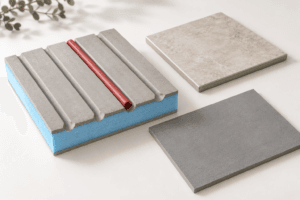
Start with XPS heating panels, EPS heating panels and underfloor heating accessories. The checklist below connects the selected products to quantities and receiving arrangements.
Download a panel and accessory enquiry worksheet
Download the bulk enquiry worksheet (Excel .xlsx). Use one line for each panel model or accessory, enter pipe outside diameter where relevant, and identify the quantity unit and pack contents. Include the approved layout as a separate attachment.
Complete the Enquiry tab with your delivery and document requirements, then email the workbook and drawings to Tina at Banarta. The worksheet records your requested supply; model compatibility, minimum quantities, prices and delivery timing are confirmed in the quotation.
Calculate from usable coverage
Ask for the effective installed coverage of a panel where interlocking or overlapping edges are involved. Separate full panels, return pieces and planned cuts. Set a project-specific allowance based on the layout and handling risks; a single waste percentage is not suitable for every room shape.
| Order line | Information to include |
|---|---|
| Panels | Model, thickness, usable coverage and quantity by room or zone |
| Return / edge pieces | Compatible references and layout quantities |
| Pipe-retention items | Fixing method, pipe size and required substrate compatibility |
| Joint tape or film | Exact material, dimensions and compatible surfaces |
| Perimeter components | Items required by the selected floor system |
| Packing | Pieces per pack, identification and agreed spare quantities |

Avoid ordering accessories by appearance
The Plastic Floor Heating Staples for Pipe Fixing range includes different pipe-size options. Confirm the selected staple dimensions, insertion requirements and any tool compatibility. A grooved or studded system may use a different retention method; do not add staples simply because they are common in other heating installations.
For Aluminum Foil Tape for Underfloor Heating Insulation Systems, specify which tape construction, width and length are required. Confirm compatibility with the actual facing or film and estimate quantities from the joint layout. Tape is not a substitute for insulation, a designed vapour-control layer or a waterproofing system.
Reconcile quantities separately for each model
Keep the layout requirement, agreed spares and pack rounding separate. This arithmetic example uses fictional models and pack sizes; it does not state Banarta packing quantities or a recommended spare allowance. Assume the buyer has already approved the layout quantities and the listed spares.
| Quantity step | Model A | Model B |
|---|---|---|
| Layout need, pieces | 101 | 24 |
| Agreed spares, pieces | 4 | 2 |
| Need plus spares, pieces | 105 | 26 |
| Pieces per pack | 10 | 8 |
| Whole packs to order | 11 | 4 |
| Ordered pieces | 110 | 32 |
| Extra pieces from pack rounding | 5 | 6 |
Calculate whole packs by rounding (layout need + agreed spares) ÷ pieces per pack upward. Model A has 5 pieces above its 105-piece requirement; model B has 6 above its 26-piece requirement. These are extra pieces caused by pack rounding, in addition to the agreed spares.
Do not combine different models before rounding or use surplus model A to cover a shortage of model B without a reviewed layout and compatibility decision. If part packs are available, obtain an explicit quotation for that option. Confirm effective installed coverage separately; outside board dimensions alone may not give usable coverage.
Make delivery usable on site
- Label different panel models and thicknesses clearly.
- Keep room or zone references on the materials schedule.
- Confirm that all required accessories are included or separately sourced.
- Check delivery quantities and damage against the agreed order record.
- Resolve substitutions before installation; a similar footprint does not establish equivalence.
Send the room layout, panel model references, pipe size and delivery destination with your enquiry. A coordinated schedule helps prevent the main panels arriving while a small but necessary component is still undefined.
Choose the panel procurement route
Heating-system distributors and project buyers should keep XPS, EPS and accessory requirements in separate order lines. This prevents a nominal floor area from hiding differences in usable coverage, profile height or pipe retention.
| Procurement question | Detailed guide or product |
|---|---|
| Aluminium-faced XPS, facing type and pipe grooves | Aluminium-faced XPS buying guide |
| EPS model, profile height and coverage | EPS supplier and model checklist |
| Pipe retention with separate staples | Plastic floor heating staples |
Buying underfloor heating pipe staples wholesale
The Banarta staple page lists options for 16, 20 and 25 mm pipe sizes. These are pipe diameters, not staple lengths. Send the actual pipe outside diameter, insulation type and thickness, required staple dimensions and installation-tool reference for compatibility review.
Ask for a representative sample to check fit in the intended tool and retention in the proposed insulation. Do not assume staples suit every grooved or studded panel; some panel systems use their own pipe-retention construction. Fixing intervals and bend restraint must follow the selected system instructions rather than a universal staples-per-m² estimate.
- Order staples by pieces and confirm pieces per bag or carton.
- Confirm loose or collated format and tool compatibility.
- State required colour, buyer SKU or label requirements for review.
- Calculate quantity from the approved circuit and fixing method, with allowance shown separately.
- Ask the quote to state minimum quantity, sample costs and delivery timing.
Review matching heating accessories and send the panel and accessory schedules together so exclusions and compatibility questions can be resolved before the order.
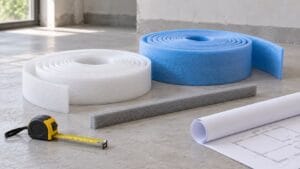
For perimeter materials, use the edge-strip roll quantity and internal joint schedule to measure approved boundary routes and round each strip specification separately.
Sources & product references
Product ranges are not a declaration for every configuration. Use current documents for the selected supply. External references explain general principles and do not certify Banarta products.